
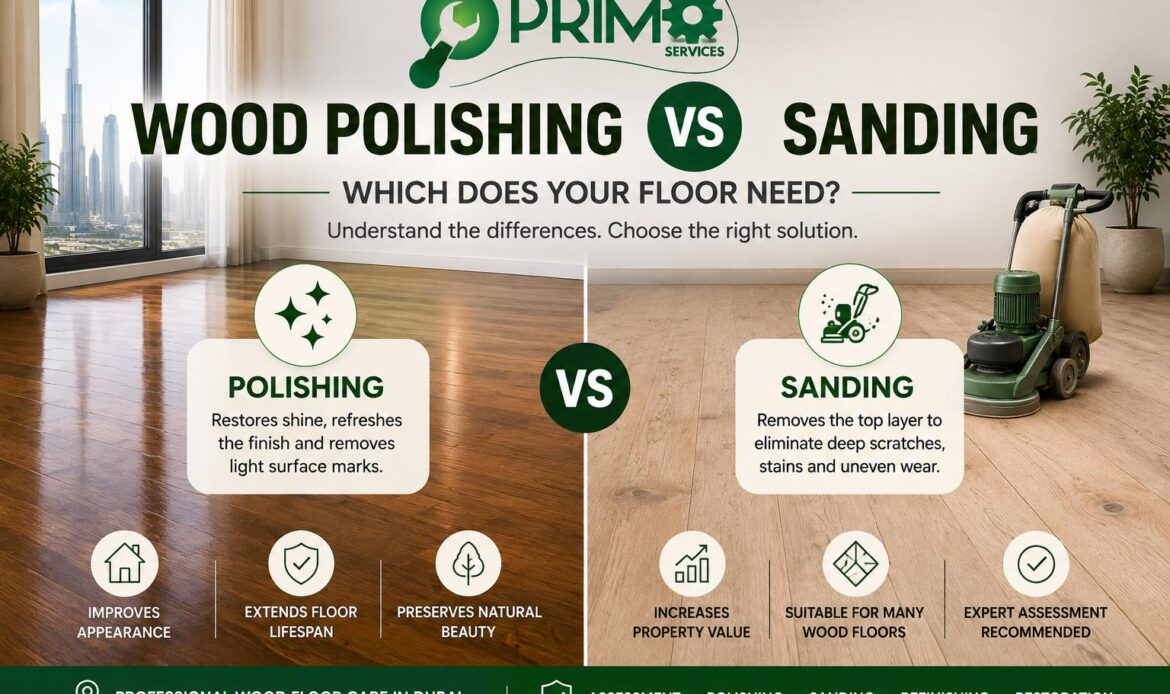
Many wooden floors in Dubai lose their shine long before they need heavy restoration. Daily foot traffic, fine sand, furniture movement, humidity and cleaning residue can make a timber or parquet floor look tired even when the wood underneath is still in good condition.
The difficult part is knowing whether the floor needs wood polishing, sanding, refinishing or a wider restoration approach. Choosing the wrong treatment can waste money, shorten the life of the floor or remove more timber than necessary.
Wood Polishing vs Sanding: Quick Comparison
| Treatment | Best For | What It Does Not Fix | Typical Disruption |
|---|---|---|---|
| Wood polishing | Dull finish, light surface marks, minor loss of shine | Deep gouges, structural damage, loose boards or failed coatings | Lower disruption |
| Buffing | Refreshing an existing coating where the surface is still sound | Deep scratches, stains inside the wood or severe wear | Low to moderate disruption |
| Sanding | Scratches, uneven coatings, worn surface layers and refinishing preparation | Rotten timber, loose subflooring or flooring with no usable wear layer | Higher disruption |
| Refinishing | Floors that need sanding followed by a new protective finish | Structural movement, severe water damage or poor installation | Moderate to high disruption |
| Restoration | More complex floors with repairs, replacement boards or deeper defects | Problems that require full flooring replacement | Varies by condition |
Simple Decision Tree
If yes, polishing or buffing may be enough. This is common where the coating is intact but has lost gloss from normal use.
Light surface scratches may improve with polishing or light abrasion, depending on the finish.
Sanding or refinishing may be needed, provided the floor has enough usable wood or wear layer.
This is usually a restoration or repair issue, not a simple polishing job.
Laminate flooring is not sanded or polished like natural timber. Damaged laminate usually needs replacement panels or another suitable repair approach.
What Is Wood Polishing?
Wood polishing is a surface-refreshing process used to improve the appearance of wooden floors where the finish is dull, lightly marked or tired. It is generally less aggressive than sanding because it does not remove a deep layer of wood.
The process may involve cleaning, light abrasion, machine buffing, polishing compounds or compatible finishing products, depending on the existing coating. The aim is to restore a cleaner, more even appearance without removing unnecessary material.
Polishing is often suitable when the floor still feels flat and stable, but the surface no longer reflects light evenly. If you are unsure whether this applies to your floor, Primo’s guide to the signs your wooden floor needs polishing explains the most common visual symptoms.
What Problems Can Polishing Solve?
- Dullness caused by daily foot traffic.
- Light surface scuffs.
- Minor uneven sheen.
- Cleaning residue that makes the floor look flat.
- General tired appearance where the coating is still sound.
What Problems Does Polishing Not Solve?
- Deep gouges that cut into the timber.
- Failed coatings that are peeling or flaking.
- Severe water damage or swelling.
- Loose parquet blocks or unstable boards.
- Floors that need a completely new finish system.
What Is Wood Floor Sanding?
Wood floor sanding is the process of removing part of the surface layer using abrasive machinery. It is used when the existing finish is too worn, scratched, uneven or damaged for polishing alone to produce a stable result.
Sanding can prepare the surface for refinishing, but it must be handled carefully. Every sanding pass removes material, so the technician needs to understand the flooring type before deciding how much sanding is safe.
What Sanding Can Help With
- Visible scratches across larger areas.
- Uneven or worn protective coatings.
- Surface-level stains that have not penetrated too deeply.
- Old finish systems that need to be removed before refinishing.
- Some unevenness in parquet or timber floors.
What Sanding Cannot Fix
- Rotten wood or severe moisture damage.
- Structural movement beneath the floor.
- Very thin engineered wood with no safe wear layer.
- Laminate flooring.
- Deep damage that requires board replacement.
What Is Refinishing?
Refinishing usually means sanding or preparing the surface and then applying a new protective finish. This may be a lacquer, oil, hardwax oil or another finish system suitable for the floor type and expected use.
Refinishing is more involved than polishing because the floor may need preparation time, dust control, drying or curing time and careful protection afterwards. It is often recommended when the old coating is worn beyond simple refresh work.
What Is Wood Floor Restoration?
Wood floor restoration is a broader term. It may include polishing, sanding and refinishing, but it can also involve repairs, replacing damaged boards, fixing loose parquet blocks or correcting previous poor work.
Restoration is the better term when the floor has multiple issues, such as scratches, failed finish, gaps, loose pieces and localised damage. In these cases, a professional should assess whether the floor can be improved in place or whether some repairs are needed first.
For broader property surface renewal work, the property restoration services page explains how Primo positions specialist surface care within wider restoration and maintenance work.
Which Flooring Types Can Be Sanded?
The flooring type is one of the most important factors. A treatment that is suitable for solid hardwood may be risky for thin engineered wood and completely unsuitable for laminate.
| Flooring Type | Can It Be Polished? | Can It Be Sanded? | Important Limitation |
|---|---|---|---|
| Solid hardwood | Usually, if the finish condition allows | Often, depending on thickness and condition | Repeated sanding still reduces material over time |
| Engineered wood flooring | Often, if the surface is suitable | Only if the wear layer is thick enough | Thin veneers can be damaged by sanding |
| Parquet flooring | Often, if stable and well bonded | Often, but loose blocks must be addressed first | Pattern, adhesive and thickness matter |
| Laminate flooring | No, not like timber | No | Damaged laminate usually needs replacement, not sanding |
| Wood-look vinyl or SPC | No, not like timber | No | These are not natural wood surfaces |
When Polishing Is Enough
Polishing may be enough when the wood surface is generally stable, the coating has not completely failed and the main issue is loss of shine. This is common in Dubai apartments where the floor is regularly cleaned but gradually becomes flat-looking from dust and foot traffic.
It may also be suitable in villas where bedrooms, corridors or living rooms show light wear but no deep damage. In these cases, polishing can be a sensible maintenance step before the floor deteriorates further.
When Sanding Is Necessary
Sanding becomes more relevant when the surface has visible scratches, worn coatings or uneven colour that cannot be corrected with cleaning or polishing. It is also used when a new finish needs to bond properly to the wood.
In Dubai villas, sanding may be considered for timber floors that have suffered from heavy furniture movement, pets, sand abrasion or long periods without maintenance. In apartments, it may be needed where an old finish has worn through in walkways or near balcony doors.
When Restoration Is the Better Option
Restoration should be considered when the floor has more than surface wear. Examples include loose parquet blocks, localised swelling, deep scratches, gaps, uneven repairs or areas where previous coatings were applied incorrectly.
A restoration plan may combine repair, sanding, refinishing and polishing. It may also identify areas that should not be sanded heavily because the flooring is engineered wood with limited wear layer.
When Not To Sand a Wooden Floor
Sanding is useful in the right situation, but it is not always the safest option. A careful inspection should happen before any sanding is approved.
- Do not sand laminate flooring.
- Do not sand engineered wood unless the wear layer is confirmed as suitable.
- Do not sand swollen or moisture-damaged boards before diagnosing the source of moisture.
- Do not sand loose parquet blocks before they are repaired or stabilised.
- Do not sand simply because a floor is dusty or dirty.
- Do not sand if the problem is mainly cleaning residue on top of the finish.
Expected Disruption, Dust and Downtime
Polishing is usually less disruptive than sanding. It may still require furniture movement, surface preparation and drying time depending on the products used, but it generally involves less dust and less downtime than a full sanding and refinishing job.
Sanding creates more disruption because abrasive machinery removes material from the floor. Professional dust-control equipment helps reduce airborne dust, but homeowners should still expect preparation, containment and cleaning after the work.
| Factor | Polishing | Sanding and Refinishing |
|---|---|---|
| Dust | Usually low | Higher, though professional dust control should be used |
| Furniture movement | Often required for clear access | Usually required more extensively |
| Downtime | Lower | Higher because finishing products may need drying or curing time |
| Noise | Moderate | Higher because sanding machinery is used |
| Best use | Maintenance and surface refresh | Worn floors that need deeper correction |
Apartment vs Villa Considerations in Dubai
Apartments often have access rules, service lift timings, noise restrictions and building management requirements. If sanding is needed, these practical details can affect scheduling and preparation.
Villas may have larger floor areas, more furniture movement and multiple rooms or levels. They may also have areas exposed to garden entrances, sand, pets and heavier family use.
Facility managers and commercial property teams should consider working hours, visitor access, dust containment and phased work. Offices, reception areas and retail floors often need a plan that reduces disruption to occupants.
Dubai Climate Considerations
Dubai’s fine dust and sand can act like a mild abrasive on wooden floors. Even when a floor is cleaned often, small particles can be dragged across the surface by shoes, furniture or cleaning tools.
Humidity and air conditioning can also affect comfort and drying conditions. A professional should account for ventilation, product compatibility and the existing finish before recommending polishing, sanding or refinishing.
Questions To Ask Before Approving Sanding
- Is my floor solid hardwood, engineered wood, parquet, laminate or another material?
- How much usable wear layer is available?
- Is sanding necessary, or would polishing be enough?
- What dust-control method will be used?
- Will furniture need to be moved out of the room?
- What finish system will be applied after sanding?
- How long before the floor can be walked on?
- Are there loose boards, gaps or moisture issues that need repair first?
Buyer Checklist
Confirm the Floor Type
Ask the technician to identify whether the floor is solid wood, engineered wood, parquet, laminate or another material before recommending sanding.
Ask About the Wear Layer
For engineered wood, sanding should only be considered when the top layer is thick enough to tolerate it safely.
Check the Finish Condition
A dull but intact coating may need polishing, while a failed coating may require refinishing.
Understand the Downtime
Ask when furniture can return, when the floor can be walked on and whether any drying or curing period applies.
Common Myths About Wood Polishing and Sanding
Myth 1: Sanding Is Always Better Than Polishing
Sanding is not automatically better. It is more aggressive and removes material, so it should be used only when the floor condition justifies it.
Myth 2: Polishing Can Remove Deep Scratches
Polishing can improve light surface marks, but deep scratches often need sanding, repair or restoration.
Myth 3: Engineered Wood Can Always Be Sanded
Engineered wood can only be sanded when the wear layer is thick enough. Thin veneers may be damaged by sanding.
Myth 4: Laminate Flooring Can Be Restored Like Timber
Laminate is not natural timber. It is not sanded or polished in the same way as wood flooring.
Practical Examples
In a Dubai apartment, a parquet floor may look dull around the living room seating area but remain stable and smooth. If the finish is intact, polishing or buffing may be the sensible first option.
In a villa, a wooden floor near a garden entrance may show heavier scratching from sand and foot traffic. If scratches are widespread and the coating is worn, sanding and refinishing may be more appropriate.
In an office or commercial space, the main reception walkway may lose its finish faster than low-traffic areas. A staged inspection can help decide whether the floor needs localised restoration or a wider refinishing plan.
Pros and Cons
| Option | Pros | Cons |
|---|---|---|
| Polishing | Lower disruption, useful for dullness, preserves more material | Not suitable for deep damage or failed coatings |
| Sanding | Can remove deeper surface wear and prepare for a new finish | More disruptive and not suitable for every floor type |
| Refinishing | Creates a renewed protective finish after preparation | Requires more planning, drying time and product selection |
| Restoration | Addresses repairs and deeper floor issues | More complex and depends heavily on inspection findings |
Summary: Which Does Your Floor Need?
If your wooden floor is mainly dull, lightly marked and structurally sound, polishing may be enough. If the floor has deeper scratches, worn coatings or uneven surface damage, sanding and refinishing may be required.
If the floor has loose boards, moisture damage, unstable parquet or previous poor repairs, restoration is usually the more accurate starting point. The safest decision comes from identifying the flooring type and inspecting the condition before work begins.
Related Wood and Restoration Services
Frequently Asked Questions
What is the main difference between wood polishing and sanding?
Wood polishing refreshes the surface appearance with minimal material removal, while sanding removes part of the top layer to correct deeper wear, scratches or failed finishes.
When is wood polishing enough?
Wood polishing may be enough when the floor is dull, lightly marked and generally stable, with an existing finish that has not completely failed.
When does a wooden floor need sanding?
Sanding may be needed when scratches, worn coatings, uneven finish or deeper surface damage cannot be improved properly with cleaning or polishing alone.
Can engineered wood flooring be sanded?
Engineered wood can only be sanded if it has a sufficiently thick wear layer. Thin veneer surfaces can be damaged if they are sanded too aggressively.
Can parquet flooring be sanded?
Parquet flooring can often be sanded if the blocks are stable and thick enough, but loose pieces or adhesive problems should be repaired before sanding.
Can laminate flooring be sanded or polished?
No. Laminate flooring is not treated like natural timber. Damaged laminate usually requires replacement panels or another suitable repair method.
Does sanding create a lot of dust?
Sanding can create dust because it removes material from the floor. Professional dust-control equipment helps reduce dust, but preparation and cleaning are still important.
Can polishing remove scratches from wooden floors?
Polishing may improve very light surface marks, but moderate scratches, deep gouges or damaged coatings usually require sanding, refinishing or restoration.
How do I know if my floor needs restoration instead of polishing?
If the floor has loose boards, swelling, gaps, deep scratches, failed coating or water damage, restoration may be more appropriate than polishing alone.
Should I choose polishing or sanding before selling or renting a property?
It depends on the floor condition. Polishing may improve presentation where wear is light, while sanding or restoration may be needed if the floor has visible damage or failed finish.
Not Sure Whether Your Wooden Floor Needs Polishing or Sanding?
Share clear photos of the floor, the affected areas and the property type. Primo can help assess whether your floor is more suited to polishing, sanding, refinishing or restoration before unnecessary work is recommended.