
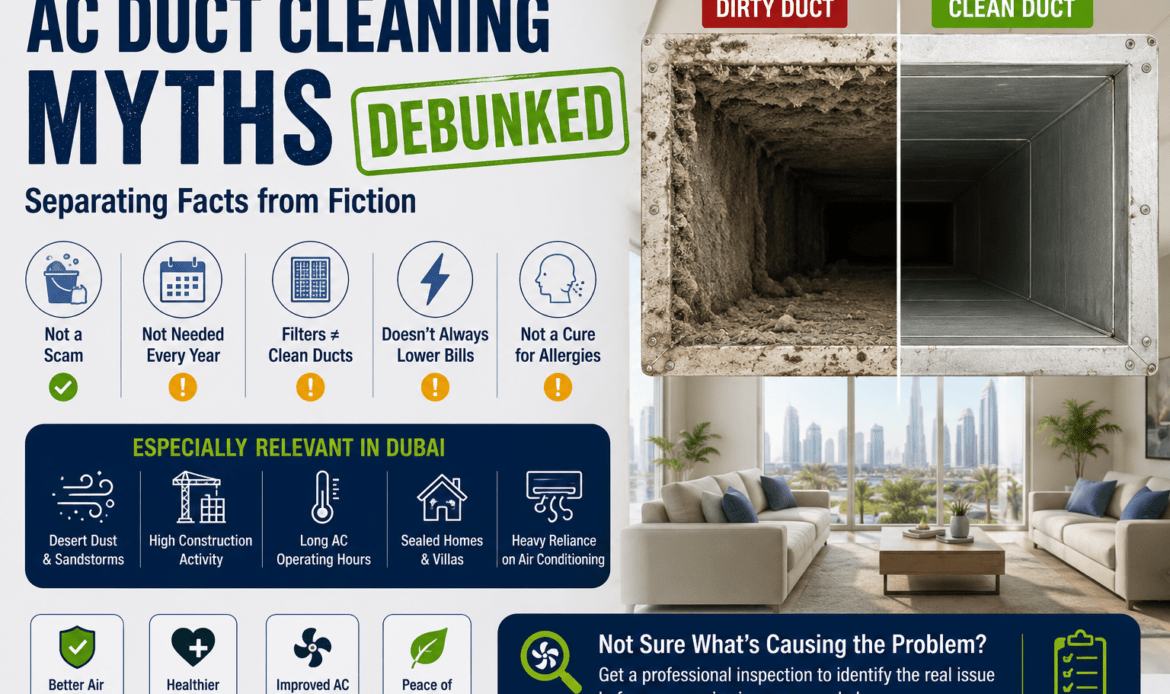
Search for advice about AC duct cleaning and you will find two extremes. Some sources present it as an essential annual service for every property, while others dismiss it as unnecessary in every situation. Neither position reflects how HVAC systems actually work.
The facts depend on the condition of the system. Dubai properties face desert dust, occasional sandstorms, nearby construction activity, and long AC operating hours. Duct cleaning can be useful when inspection finds accumulated debris, renovation dust, pest contamination, moisture-related buildup, or material that is being distributed through the air path. It may offer little value when the ducts are already clean and the real problem is a dirty filter, contaminated coil, drainage issue, damaged insulation, or poor airflow distribution.
This guide separates common AC duct cleaning myths from practical HVAC best practices. It is written for Dubai homeowners, tenants, villa owners, facility managers, and commercial property teams who want to understand what duct cleaning can do, what it cannot do, and when an inspection makes financial sense.
Why indoor air deserves a wider assessment
The U.S. Environmental Protection Agency reports that Americans spend approximately 90% of their time indoors and that concentrations of some pollutants are often two to five times higher indoors than outdoors. These figures show why indoor-air sources matter, but they do not prove that any particular duct system is contaminated or needs cleaning.
The short answer
Does AC duct cleaning work? Yes, when technicians identify contamination inside the duct system and remove it using suitable equipment. No, it is not a cure for every cooling, energy, dust, odour, or health complaint. Diagnosis should come before the service.
Will Duct Cleaning Help With This Problem?
| Problem | Will duct cleaning help? |
|---|---|
| Dust blowing from vents | ✅ Usually, if ducts are the confirmed source |
| Renovation debris | ✅ Yes, when debris entered the air path |
| Dirty evaporator coil | ❌ Coil cleaning is needed |
| Weak airflow | ⚠️ It depends on the cause |
| High DEWA bill | ⚠️ Sometimes, but check the whole system |
| Allergy concerns | ⚠️ It may help if ducts are contaminated |
| Refrigerant issue | ❌ No |
| Blocked condensate drain | ❌ No |
Myth 1: “AC Duct Cleaning Is a Scam”
Some people believe duct cleaning is a scam because they paid for a service without seeing a clear change afterward. This can happen when a company recommends cleaning without inspecting the system, cleans only the visible grilles, uses unsuitable equipment, or promises results that duct cleaning cannot realistically deliver.
A legitimate service focuses on contamination inside supply ducts, return ducts, accessible plenums, diffusers, and other agreed components. Technicians should explain what they found, which areas they will clean, how they will control loosened dust, and whether other parts of the HVAC system require separate attention.
When duct cleaning is genuinely beneficial
Cleaning can be worthwhile after dusty renovation work, when visible debris sits inside the ductwork, when pests have entered the system, or when material is repeatedly appearing at vents. It can also be appropriate when inspection identifies contamination associated with a persistent musty odour.
When it may be unnecessary
If camera inspection and accessible checks show clean duct surfaces, cleaning may not solve the complaint. Weak cooling may instead relate to the evaporator coil, condenser coil, filter, refrigerant condition, thermostat settings, installation, or airflow balance. A responsible company should be willing to say when duct cleaning is not the first service to book.
Duct cleaning is a legitimate maintenance service when inspection confirms a relevant condition. Unnecessary recommendations and incomplete methods create the poor experiences behind this myth.
Myth 2: “Every Home Needs Duct Cleaning Every Year”
There is no universal annual schedule that suits every Dubai property. A quiet apartment occupied by two adults has different conditions from a villa with pets, frequent open doors, recent construction, and several heavily used AC zones. Commercial offices, restaurants, salons, clinics, and retail units also have different occupancy and filtration demands.
The sensible approach is condition-based inspection. Filters should be checked regularly, while duct inspection frequency can reflect occupancy, dust exposure, previous contamination, renovation history, smoking, pets, and complaints such as recurring debris or odour.
For example, filters in an apartment beside an active construction site may load unusually quickly even when the property is well maintained. That pattern justifies checking filtration, fresh-air entry, coils, and representative duct sections before assuming full duct cleaning is required.
Practical inspection intervals
| Property condition | When to consider inspection | What may change the timing |
|---|---|---|
| Normal apartment use | When symptoms appear or during a planned HVAC condition review | Pets, smoking, nearby construction, poor filtration |
| Villa with higher dust exposure | Periodic inspection based on filter loading and visible conditions | Garden access, frequently opened doors, multiple occupants |
| Recently renovated property | After work finishes and before normal occupation where ducts were exposed | Gypsum cutting, sanding, demolition, uncovered grilles |
| Commercial office | According to maintenance records, complaints, and system inspection | Occupancy, operating hours, fresh-air intake, fit-out work |
| Previous pest or moisture issue | After the source is corrected and the affected system is assessed | Extent of contamination and duct material |
These are inspection prompts, not automatic cleaning schedules. A clean system does not need cleaning simply because a calendar date has arrived.
Properties need different inspection schedules. Cleaning should follow evidence of contamination, not a universal annual rule.
Myth 3: “Changing the Air Filter Is the Same as Cleaning the Ducts”
An air filter and a duct-cleaning service perform different jobs. The filter captures a portion of particles moving through the return air before they reach sensitive HVAC components. Its effectiveness depends on filter type, fit, condition, airflow, and replacement or cleaning frequency.
A filter cannot remove dust that is already attached to duct surfaces, sitting inside bends, trapped near damp insulation, or collected in plenums. It also cannot retrieve construction debris, packaging, or material that entered while grilles were uncovered.
At the same time, duct cleaning does not replace filter maintenance. Installing a clean filter after a service helps protect the system, but that filter still requires routine checks. A heavily clogged filter can restrict airflow and allow gaps or bypass leakage to become more significant.
The two tasks complement each other when the ducts genuinely need cleaning. For many properties, consistent filter care is the first and most frequent maintenance step, while duct cleaning is occasional and condition dependent.
Filters reduce particles moving through the system. Duct cleaning removes existing contamination from accessible duct surfaces and components. One does not replace the other.
Myth 4: “Duct Cleaning Will Instantly Lower My DEWA Bill”
Energy use depends on cooling demand, thermostat settings, equipment efficiency, building insulation, coil condition, filters, duct leakage, airflow, outdoor temperature, and operating hours. Duct cleaning addresses only one possible part of this wider picture.
Heavy debris or a physical restriction can affect airflow in some systems. Removing that restriction may help the air path operate as intended. However, normal dust on duct surfaces is not automatically the main reason for a high electricity bill.
Dirty evaporator and condenser coils often have a more direct relationship with cooling performance because buildup interferes with heat transfer. Clogged filters can also restrict airflow. If the system runs for long periods but rooms remain warm, professional AC coil cleaning may be more relevant when inspection confirms coil contamination.
Uneven airflow can cause occupants to lower the thermostat to cool one difficult room, making the rest of the system work harder. In that situation, an air balancing service can measure supply airflow and identify distribution problems. Damaged or poorly insulated ducts may require repair rather than cleaning.
Duct cleaning may help where contamination restricts airflow, but it does not guarantee lower bills. Filters, coils, insulation, leakage, airflow balance, equipment condition, and thermostat use may have greater impact.
Myth 5: “Duct Cleaning Solves Every Allergy Problem”
Allergies and respiratory symptoms can have many causes, including outdoor pollen, dust mites, pets, fabrics, cleaning products, humidity, damp building materials, smoke, and individual medical conditions. The HVAC system is only one potential pathway.
Duct cleaning may reduce loose dust or identified contamination within the air path. That can be useful when the system is distributing material into occupied rooms. It is not a medical treatment, does not diagnose allergies, and cannot guarantee that symptoms will improve.
Indoor air quality in Dubai also depends on filtration, fresh-air management, humidity, housekeeping, water leaks, and what enters through doors and windows. Properties with continuing symptoms should investigate the building condition and seek appropriate medical advice rather than relying on one maintenance service.
Avoid claims that duct cleaning cures asthma, eliminates all mould, or removes every allergen. Those statements are not supported by a normal service scope and create unrealistic expectations.
Duct cleaning can remove identified contamination from the HVAC air path, but allergies have multiple causes and require appropriate medical and environmental assessment.
Myth 6: “If I Can’t See Dust, My Ducts Must Be Clean”
Looking through a supply grille provides only a limited view. Dust may collect farther inside straight sections, around bends, in return ducts, at plenums, behind diffusers, or near access points. A grille can look clean while another part of the system contains debris.
The reverse is also true: a dusty diffuser does not prove that the entire duct network is heavily contaminated. Dust can settle on the face of a grille because of room conditions, condensation, air leakage around the opening, or infrequent surface cleaning.
A proper inspection uses accessible openings and, where useful, camera equipment to examine representative areas. Technicians should look at both supply and return paths rather than judging the whole system from one easy-to-reach vent.
Inspection findings should also distinguish loose removable dust from damaged insulation, corrosion, moisture staining, or building material that cleaning cannot repair.
Contamination can sit beyond the visible grille, but a dusty grille alone does not prove that every duct is dirty. Representative internal inspection provides better evidence.
Myth 7: “Sanitising Alone Cleans the Ducts”
Spraying a chemical into dusty ductwork does not remove the dust. Physical source removal is the primary cleaning principle: loosen contamination using methods suitable for the duct material, maintain controlled airflow or negative pressure, and capture removed particles with appropriate filtration.
Sanitising products may be considered in limited circumstances after physical cleaning, provided the product is suitable for the application, the treatment follows its label, and occupants understand what will be used. It should not serve as a shortcut for cleaning.
Property owners should ask for the product name, safety documentation, intended purpose, treated surfaces, required ventilation, and whether treatment is optional. Be cautious when a company promotes fogging as the complete service without discussing debris removal.
Chemicals also cannot fix wet insulation, active water leaks, damaged ducts, or an unresolved contamination source. Those issues require correction before any optional treatment is considered.
Sanitisation does not replace physical cleaning. Remove the contamination first, correct its source, and use any suitable treatment only for a clearly explained purpose.
Myth 8: “New Homes Never Need Duct Cleaning”
A newly completed or renovated property can contain more construction dust than an occupied home. Gypsum cutting, wall sanding, cement work, drilling, paint preparation, joinery, tile cutting, and ceiling work can release fine material. If contractors leave grilles or duct openings uncovered, the ventilation system may collect that debris.
Dubai fit-out projects often involve multiple trades working around ceiling-concealed FCUs and duct networks. Packaging, cable offcuts, plaster fragments, screws, or protective material may remain near accessible openings. Paint overspray and adhesive residue can also appear around diffusers.
A typical example is a newly handed-over villa where ceiling grilles remained uncovered during gypsum sanding. Fine residue may reach supply openings and return paths even though the AC equipment itself is new.
Not every new property needs full duct cleaning. If contractors protected the system and post-construction inspection shows clean ducts, cleaning may offer no additional value. The correct step is to inspect before occupation, especially where construction dust appears at vents or filters load unusually quickly.
New and newly renovated properties can contain construction debris. Inspect exposed systems after work rather than assuming age guarantees cleanliness.
Myth 9: “All Duct Cleaning Companies Clean the Same Way”
Equipment, training, scope, containment, and reporting vary considerably. Some providers clean only grilles and nearby duct sections. A more complete service defines the system boundaries, protects the property, creates controlled airflow, agitates contamination, captures particles, and verifies the result.
Negative pressure and HEPA filtration
Negative-pressure equipment helps draw loosened material toward a collection point instead of releasing it into occupied rooms. HEPA-filtered collection equipment can control fine particles when correctly maintained and used.
Rotary brushes and air whips
Mechanical agitation tools dislodge debris, but technicians must match them to duct size, material, condition, and access. Aggressive brushes that suit rigid metal ducts may be inappropriate for fragile liners or flexible ducts.
Camera inspection and project evidence
Camera checks help document representative conditions before and after work. Photos should identify the actual system areas rather than relying on generic images. Reports are particularly useful for landlords, facility managers, offices, and multi-unit properties.
NADCA-style procedures
Industry-style procedures emphasize source removal, system inspection, contamination control, trained technicians, and appropriate tools. A certification logo alone does not prove the exact scope performed on a particular job, so customers should still request a written method and deliverables.
Methods and service quality vary. Compare the inspection process, equipment, full scope, containment, technician training, and evidence supplied after completion.
Myth 10: “Duct Cleaning Damages Flexible Ducts”
Flexible ducts need more careful handling than rigid metal ductwork, but appropriate cleaning does not automatically damage them. Technicians should identify the duct material and condition before selecting brushes, air tools, pressure levels, and access methods.
Aggressive rotary equipment, oversized brushes, sharp tools, or careless access can tear flexible duct liners or separate connections. Experienced technicians use gentler methods and avoid forcing equipment through tight bends.
Cleaning is not the correct solution when flexible ductwork is already crushed, torn, delaminated, heavily deteriorated, wet, or contaminated beyond practical recovery. Replacement or repair may be safer and more economical. The same applies when insulation has failed or duct routing creates a serious airflow restriction.
Customers should ask the company to report existing damage before work begins. This separates pre-existing problems from service-related concerns and allows the team to recommend repair where needed.
Incorrect tools can damage flexible ducts. Proper inspection, suitable agitation, and experienced handling reduce that risk, while badly deteriorated ducts may need replacement instead.
A Simple Duct Cleaning Inspection Flow
Dust or debris problem?
↓
Visible inside representative duct sections?
↓
Yes: arrange a proper inspection.
↓
Contamination confirmed?
↓
Yes: define and clean the affected duct system.
No: investigate filters, coils, drainage, room dust sources, duct leakage, or airflow balance.
This decision path prevents a symptom such as dust or weak airflow from being treated as automatic proof that duct cleaning is necessary.
When Is AC Duct Cleaning Actually Recommended?
Consider arranging an inspection when there is a clear event, visible condition, or repeated symptom. The following situations provide stronger reasons than an arbitrary cleaning schedule:
- After renovations: especially when contractors performed gypsum, sanding, demolition, ceiling, or paint work near uncovered HVAC openings.
- Visible contamination: loose debris, heavy deposits, or material documented inside representative supply or return sections.
- Persistent dust from vents: after checking filters, room dust sources, and grille cleanliness.
- Musty smells: where inspection traces the odour to duct contamination rather than coils, drainage, damp walls, or another source.
- Pest infestation: after pest access has been stopped and affected duct sections have been assessed.
- Airflow issues: when debris or a physical obstruction is suspected, while recognising that balancing, duct design, filters, and equipment condition may be more relevant.
- Confirmed mould-like contamination: after identifying and correcting the moisture source and determining which components are affected.
If inspection confirms contamination, AC duct cleaning in Dubai should include a defined scope and evidence of the system condition. If symptoms overlap, Primo’s complete AC services guide can help distinguish cleaning, airflow, coil, installation, and ductwork requirements.
Questions to Ask Before Hiring a Duct Cleaning Company
A short technical conversation can reveal whether a quotation covers the whole relevant system or only the most visible parts. Ask:
- What equipment do you use? The company should explain its collection, filtration, agitation, and inspection tools.
- Do you clean return ducts? Return paths are part of the air system and should not be ignored when included in the agreed scope.
- Do you clean supply ducts? Confirm how branches, diffusers, and accessible plenums are handled.
- Will I receive before-and-after photos? Ask for images from identifiable, representative parts of your system.
- Is the coil included? Coil cleaning is a separate task unless the quote explicitly includes it.
- Is sanitisation optional? Request the product details and purpose before approving chemical treatment.
- How long does the job take? Timing should reflect the number of units, access, duct layout, property protection, and contamination level.
- Are technicians trained? Ask who supervises the work and how the team handles rigid, lined, and flexible duct materials.
- What is excluded? Clarify repairs, ceiling access, damaged ducts, coil cleaning, filters, drainage, and reinstatement.
- How will you protect the property? Discuss furniture, floors, ceiling openings, occupied areas, and dust containment.
A clear quote should connect the recommended work to inspection evidence. Be cautious of guaranteed energy savings, medical promises, unexplained chemical fogging, or a price that does not identify the number of systems and service scope.
Frequently Asked Questions
Is AC duct cleaning worth it for every Dubai property?
No. It is worth considering when inspection identifies relevant contamination, renovation debris, pest material, or another condition inside the ducts. Clean systems do not benefit from unnecessary cleaning.
Does duct cleaning reduce dust on furniture?
It may reduce dust coming from contaminated ductwork, but furniture dust also enters through doors, windows, clothing, fabrics, pets, and normal activity. The source should be identified first.
Can duct cleaning improve weak airflow?
It can help if debris physically restricts the air path. Weak airflow can also result from filters, coils, dampers, duct design, leakage, fan settings, or balancing problems.
Should ducts be cleaned before moving into a new villa?
Inspect them first, particularly after construction or renovation. Cleaning is reasonable when the inspection finds gypsum, cement dust, packaging, or other debris inside the system.
Is chemical fogging necessary after every duct cleaning?
No. Physical source removal is the main cleaning process. Any optional treatment should have a defined purpose, suitable product, documented instructions, and customer approval.
Can I inspect AC ducts using my phone camera?
You can photograph the area immediately behind an accessible grille, but this does not show bends, returns, plenums, or distant branches. Professional camera inspection provides a broader representative view.
Does a black mark around a diffuser mean mould is inside the ducts?
Not necessarily. Marks can result from dust, condensation, air leakage around the grille, or room conditions. Inspection is needed before identifying the material or recommending treatment.
Can duct cleaning remove cigarette or cooking odours?
It may remove residue within contaminated ducts, but odours can remain in walls, ceilings, filters, coils, fabrics, insulation, and other surfaces. The full source must be assessed.
How do I know whether the return ducts were cleaned?
Ask for a written scope and before-and-after images from identifiable return sections. The report should distinguish return ducts from supply ducts and visible grilles.
Should damaged duct insulation be cleaned or replaced?
Wet, deteriorated, delaminated, or badly contaminated insulation may require replacement. Cleaning cannot restore damaged material, so technicians should report its condition before proceeding.
Can duct cleaning be completed while an office is occupied?
Sometimes, depending on access, containment, noise, operating requirements, and the number of zones. Commercial work may be scheduled by area or outside working hours to reduce disruption.
What proof should I receive after AC duct cleaning?
Useful proof includes a defined service report, identifiable before-and-after photos, notes about inaccessible or damaged areas, and recommendations limited to conditions actually observed.
Not Sure Whether Your Ducts Need Cleaning?
Not every HVAC problem requires duct cleaning. If you are unsure whether the issue comes from dirty ducts, a contaminated coil, poor airflow, blocked drainage, or another HVAC fault, start with a professional inspection. Identifying the root cause before recommending a service helps avoid unnecessary work and directs the property toward the correct solution.
Share your Dubai area, property type, number of AC units, and the problem you are noticing. Primo can advise whether duct inspection, coil cleaning, airflow testing, or another HVAC check is the sensible next step.