
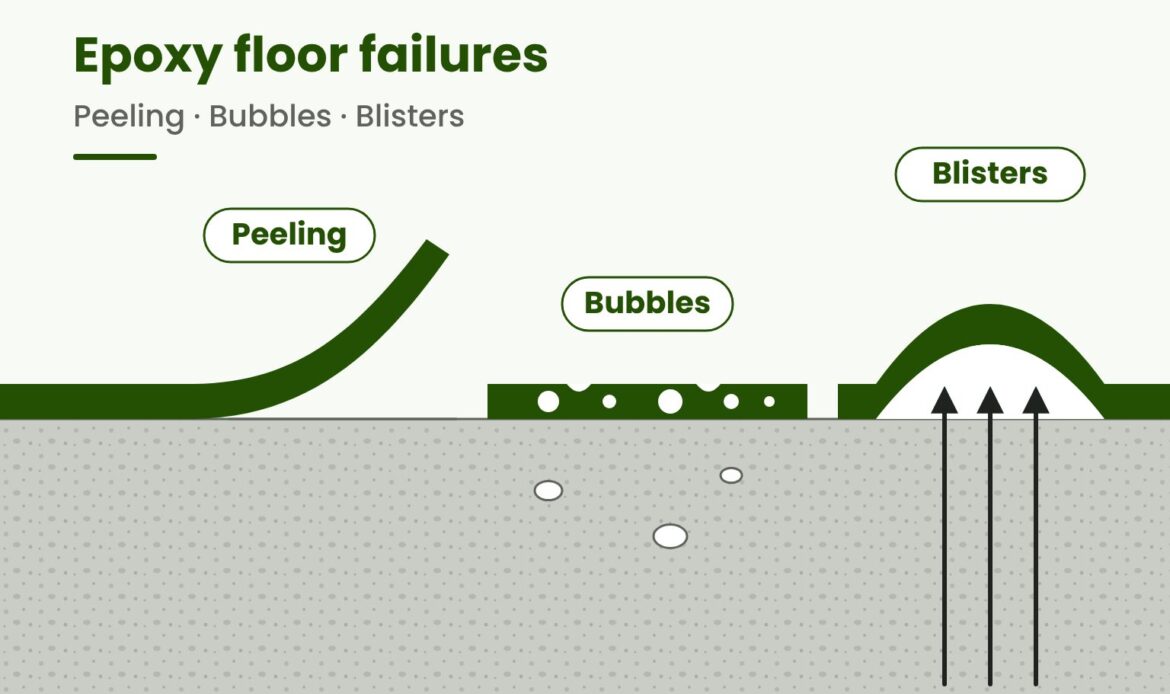
An epoxy floor that lifts at the edges, develops bubbles or pinholes, or forms raised blisters a few weeks after installation is frustrating, especially when the coating itself looked perfect on the day it was finished. In most cases the resin is not the root cause. Epoxy failures usually trace back to one of four things: moisture in the concrete, the way the surface was prepared, the conditions during application, or a system that was never suited to how the floor is used.
This guide explains each cause, how the symptoms differ, how to reduce the risk on a new floor in Dubai, where hot slabs, humidity and sun exposure add their own pressures, and when a professional assessment is worth arranging. It is general guidance; the cause of a specific failure can only be confirmed by inspecting the floor.
Quick Answer
Peeling (also called delamination) usually means the coating never bonded properly, most often because the concrete was not mechanically prepared, was contaminated with oil or old coatings, or was too weak at the surface. Bubbles and pinholes often come from air escaping from the concrete while the coating cures (outgassing), which is more likely when the slab is warming up. Blisters that appear later are frequently linked to moisture or vapour moving up through the slab. A fourth group of problems comes from using a system that does not suit the floor, such as a thin coating under vehicle traffic or a standard epoxy in direct sun. Patching the symptom without addressing the cause tends to lead to the same failure again.
Peeling, Bubbles and Blisters Are Different Problems
The three words are often used interchangeably, but they describe different defects and usually point in different directions. Noting which one you are looking at, where it appears and when it started is the most useful first step.
| What you see | What it often points to | What is worth checking |
|---|---|---|
| Coating lifting at edges, joints or in sheets | Poor adhesion: inadequate preparation, contamination or a weak concrete surface | What is on the back of the lifted piece, and what the concrete underneath looks like |
| Small craters, pinholes or bubbles visible soon after installation | Air escaping from the concrete during curing (outgassing), or air mixed into the coating | When it appeared, and whether the slab was warming up during application |
| Raised, rounded blisters appearing weeks or months later, sometimes containing liquid | Moisture or vapour moving up through the slab | Whether the floor is on the ground or below ground, and whether moisture was tested before coating |
| Coating lifting under car tyres, wearing through in traffic lanes, or discolouring in sunlight | A system that does not suit the use or exposure | The coating type and thickness, and how the floor is actually used |
| Top coat separating from the coat below it | Problems between coats, such as recoating outside the manufacturer’s window or a contaminated surface between coats | Whether the layers came apart from each other rather than from the concrete |
If you are not yet sure what an epoxy floor system consists of, our guide to what epoxy flooring is and how it works covers the basics.
Cause 1: Moisture in the Concrete
Concrete can look dry on the surface while still holding moisture inside the slab, and moisture can also rise from the ground beneath it. An epoxy coating forms a relatively impermeable layer over the concrete, so moisture vapour moving upwards can collect beneath it. Over time that pressure can push the coating up into blisters or break its bond.
This is why resin manufacturers set moisture limits before their products are applied. The Gulf edition of one major manufacturer’s epoxy floor coating data sheet, for example, sets a maximum moisture content for the concrete, states that there must be no rising moisture, and directs the installer to a separate temporary moisture barrier product where readings are too high. The exact limit and test method depend on the product, so the relevant data sheet is the reference, not a general rule.
Where moisture is more likely to be a factor
- Ground-floor slabs and garages laid directly on the ground, especially where there is no effective vapour barrier under the slab.
- Basements and below-ground areas, where groundwater pressure can be a continuing source.
- Recently poured concrete that has not dried sufficiently.
- Areas next to planters, irrigated landscaping, wet rooms or a known leak.
Moisture problems are one of the main reasons a site assessment comes before an epoxy quotation. Primo’s epoxy flooring service starts with a review of the concrete’s condition and moisture before a system is recommended.
Cause 2: Surface Preparation
Epoxy needs a clean, sound and suitably textured concrete surface to grip. Smooth, power-trowelled concrete, the weak powdery layer often found on top of a slab, oil and grease, curing compounds, sealers, paint and old coatings can all stop the coating from bonding properly. A coating applied over any of them may look fine at first and then peel when it is put under load or temperature change.
Preparation for a resin floor is normally mechanical, such as diamond grinding or shot blasting, rather than a wash and a coat. The same manufacturer’s data sheet requires the concrete to be sound, clean, dry and free of contaminants, with the weak surface layer removed mechanically before coating. Dealing with contamination that has soaked into the concrete can be difficult: oil absorbed deep into a garage slab may continue to affect adhesion even after the surface looks clean.
The main preparation steps
- Assess the concrete condition and moisture.
- Remove old coatings, sealers and contamination.
- Grind or shot blast the surface.
- Remove dust and loose material.
- Prime, then apply the coating system.
The exact preparation depends on the floor, which is why it is decided after the concrete has been inspected rather than assumed.
What the Lifted Coating Can Tell You
- Bare, smooth concrete underneath and a clean back on the coating: the coating did not bond to the surface. Preparation or contamination is the usual suspect.
- A layer of concrete stuck to the back of the coating: the bond held, but the top of the concrete was weak and broke away.
- The top coat separated from the coat below: the problem lies between coats rather than at the concrete.
These are indications, not a diagnosis, but they help a contractor focus the inspection.
Cause 3: Dubai’s Temperature and Humidity
Resin coatings are sensitive to the temperature of the concrete, the temperature and humidity of the air, and how those change while the coating cures. Dubai’s climate makes several of these factors more prominent.
Hot and warming slabs
Concrete contains small voids that hold air. When the slab warms up, that air expands and moves out through the surface. If it escapes while the coating is still liquid, it can leave bubbles, craters or pinholes. Technical guidance from a construction-chemicals manufacturer notes that rising surface temperature signals a higher risk of outgassing and that applying as the air is cooling, such as in the evening, lowers it. A slab exposed to the sun through a garage door or large windows, or one in a space where air conditioning is switched on and off, can change temperature quickly.
Heat also matters for the product itself. The Gulf data sheet referred to above gives minimum and maximum temperatures for both the concrete and the air during application, with an upper limit of 35°C. An exposed slab in a Dubai summer can exceed that during the day, which is one reason application timing and temperature control need to be planned rather than assumed.
Humidity and condensation
Resin manufacturers typically require the concrete to stay a few degrees above the dew point during application and curing, so that condensation does not form on the surface. The same data sheet sets this at 3°C above the dew point, gives a maximum relative air humidity, and notes that high humidity increases the risk of “blooming”, a cloudy or greasy deposit on the surface. Humid coastal conditions, and cooled interiors where warm humid air is let in, both make this a real consideration.
Mixing and application
Air can also be introduced into the coating itself through fast mixing, an unsuitable mixing paddle or over-rolling. Thick, high-build coatings show trapped air more readily. A porous or rough slab is commonly primed first with a low-viscosity primer that penetrates the surface voids and reduces the air available to escape into the following coats.
Cause 4: The Wrong System for the Floor
Not every product sold as epoxy floor paint is designed for the same job. Problems often appear when the system is chosen for appearance or price rather than for how the floor will be used.
- Vehicle traffic: hot tyres can soften and lift thin, poorly bonded coatings, especially in garages and car parks. Coatings for vehicle areas generally need proper preparation and an appropriate build thickness.
- Sunlight and outdoor exposure: many standard epoxies discolour when exposed to UV light. The Gulf data sheet referred to above notes that its coating may show some discolouration and colour variation under direct sunlight. Areas in direct sun often need a different system or topcoat.
- Chemicals, cleaning and heat: commercial kitchens, workshops and plant rooms can expose a floor to chemicals, hot water or aggressive cleaning that a light-duty coating is not designed to resist.
- Movement and cracks: a rigid coating will not hold together across cracks that are still moving. Structural movement needs separate assessment before any coating.
The range of environments epoxy is used in is covered in our article on common applications of commercial epoxy flooring.
Practical Diagnostic Considerations
Before deciding what to do about a failing floor, a few observations make the inspection more productive. Collecting them, with photographs, is also useful when you contact the original installer. What separated from what, covered above, is the other key observation.
- Timing: did the problem appear within days of installation, or months later? Early bubbles and pinholes often relate to application conditions; later blisters more often relate to moisture.
- Location: is it spread across the floor, or concentrated near walls, doors, planters, drains, tyre tracks or areas in direct sun?
- Pattern: isolated spots, lines along cracks or joints, or large sheets lifting?
- History: was there a previous coating or sealer? Was moisture tested? What product and thickness were used?
- Use: has the use of the floor changed since it was coated, for example from storage to vehicle parking?
Localised damage caused by a one-off impact is a different situation from a failure that is spreading across the floor. Where the cause is moisture or poor adhesion over a large area, local patching may not last, because the underlying problem is still present.
When the Real Problem Is Water, Not the Coating
If blisters keep returning near a wall, in a basement or below a wet area, the coating may simply be showing a water problem rather than causing one. Recoating over continuing water ingress treats the symptom. In those cases it is worth investigating the source first. Primo’s waterproofing services cover roofs, wet areas and basements, where the system has to be chosen for the type of exposure.
How to Prevent Epoxy Coating Failures on a New Floor
- Ask how the concrete’s condition and moisture will be assessed before a system is recommended.
- Expect mechanical surface preparation rather than coating straight over the existing surface.
- Ask how existing coatings, sealers or oil contamination will be dealt with.
- Make sure the system suits the actual use: vehicles, chemicals, frequent cleaning, sun exposure or slip resistance.
- Discuss when the work will be done and how the space will be kept at a suitable temperature and humidity during application and curing.
- Respect the curing and return-to-service time before putting the floor back into use.
These are the same considerations described in the scope of Primo’s epoxy flooring work, and they apply whichever contractor you choose. If you are still deciding between floor finishes, our surface finishes and protection overview explains where epoxy fits alongside the alternatives, and our comparison of epoxy and microcement flooring covers the most common choice for interiors.
When a Professional Assessment Is Necessary
Some problems are cosmetic and stay put. Others are signs of a cause that will keep working beneath the coating. An on-site assessment is worth arranging when:
- peeling or blistering is spreading, or has come back after a previous repair;
- the affected area is large, or the coating is lifting in sheets;
- blisters are on a ground-floor or basement slab, or near walls, planters or wet areas, where moisture may be involved;
- lifted edges or broken coating create a trip hazard, or the floor is in a vehicle, food or other working area that cannot be taken out of use for long;
- you are planning to recoat or replace the floor and do not know what is underneath or why the first coating failed.
An assessment looks at the concrete as well as the coating, because that is where most failures start. If you are planning a new epoxy floor, Primo can inspect the concrete and recommend a system and preparation method before quoting. Primo’s epoxy repair work is limited to floors that Primo originally installed: if Primo installed your floor and you have noticed a problem, send photographs and the installation details so it can be reviewed. Primo does not repair epoxy floors installed by other contractors; for those, the original installer and the product data sheet are the first points of reference.
Planning an Epoxy Floor in Dubai?
Send us your Dubai area, the floor size, how the space is used and a few photographs of the concrete on WhatsApp. Primo will assess the floor, explain which system and preparation suit it, and give you a quotation before you commit.
Related Services
Frequently Asked Questions
Why is my epoxy floor peeling or delaminating?
Peeling usually means the coating did not bond well to the concrete. Common reasons are inadequate mechanical preparation, oil or old coatings on the surface, a weak concrete surface, or moisture coming up through the slab. An inspection of the lifted areas helps narrow down the cause.
What causes bubbles in a new epoxy floor?
Bubbles and pinholes that appear soon after installation are often caused by air escaping from the concrete while the coating cures, which is more likely when the slab is warming up. Air mixed into the coating during mixing or rolling can also cause them.
Are blisters in epoxy caused by moisture?
Often, especially when they appear weeks or months later on ground-floor or below-ground slabs. Moisture and vapour moving up through the concrete can collect under the coating and push it up. Other causes are possible, so the floor should be checked.
Does Dubai’s heat affect epoxy installation?
It can. Resin products have temperature limits for the concrete and the air during application, and a warming slab increases the risk of outgassing. Timing the work and controlling the temperature and humidity of the space are part of planning an epoxy floor in Dubai.
Can a failed epoxy floor just be patched?
Small, isolated damage can sometimes be repaired locally. Where the cause is moisture or poor adhesion over a wider area, a patch may fail again because the underlying problem remains. The cause needs to be identified first.
Can epoxy be used outdoors in direct sun?
Many standard epoxies discolour in sunlight, and some manufacturers state this on their data sheets. Areas exposed to direct sun often need a different system or a suitable topcoat, chosen for that exposure.
When should a failing epoxy floor be professionally assessed?
When peeling or blistering is spreading or keeps coming back, when a large area is affected, when moisture may be involved, or when the damage creates a safety or operational problem. An assessment looks at the concrete as well as the coating, because that is where most failures start.
Sources
- Sherwin-Williams: Why Does My Epoxy Floor Have Bubbles?
- Euclid Chemical (via For Construction Pros): How to Prevent Coating Defects Caused by Concrete Outgassing
- Sika Gulf: Sikafloor-264 Product Data Sheet (one product, cited as an example; limits differ between products)