
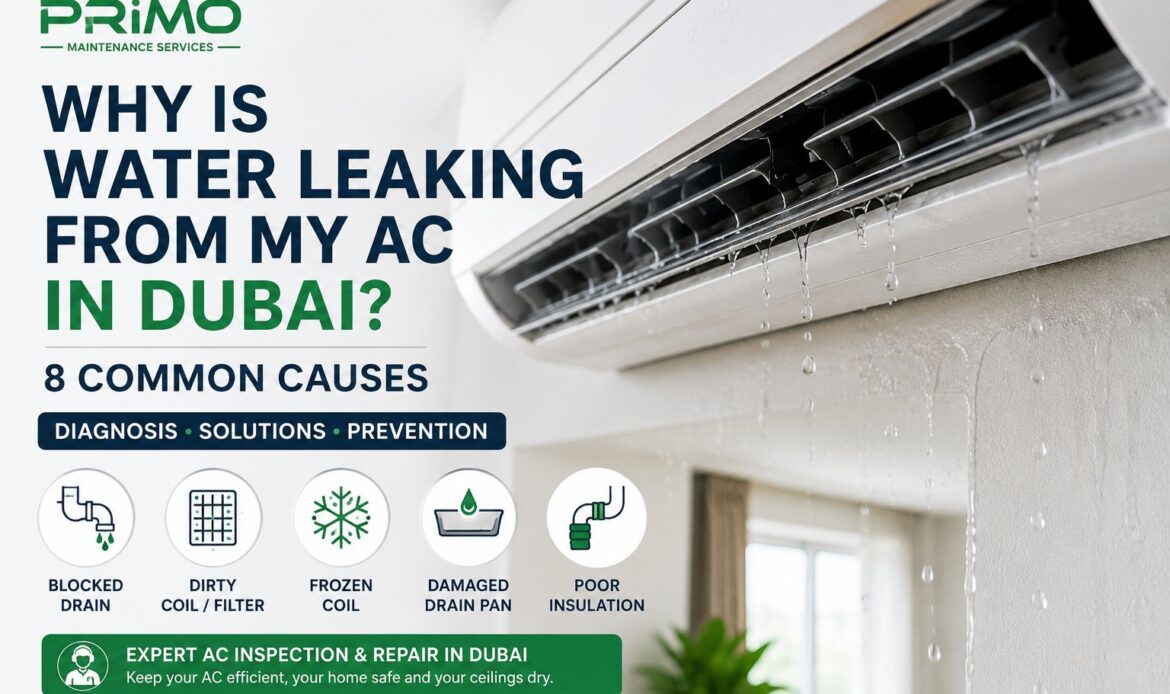
Water leaking from an AC is one of the most common cooling problems in Dubai homes, apartments, villas and offices. Because air conditioning systems run for long hours through hot and humid months, even a small drainage or airflow issue can quickly turn into visible dripping, ceiling stains or water around the indoor unit.
In many cases, the leak is not caused by the AC “making too much water”. Condensation is a normal part of the cooling process. The problem starts when that water cannot drain away properly, when the coil becomes too cold, or when installation, insulation or maintenance issues allow moisture to appear where it should not.
Quick AC Water Leak Diagnosis
The exact cause of an AC water leak should be confirmed by inspection, but the symptoms below can help you understand what may be happening before booking a service.
| Symptom | Most Likely Cause |
|---|---|
| Water dripping from indoor unit | Blocked condensate drain |
| Ice on indoor unit | Frozen evaporator coil |
| Water after AC is switched off | Frozen coil thawing |
| Ceiling stains | Drain pan or concealed drain issue |
| Condensation on pipes | Poor insulation |
This guide explains the most common reasons for AC leaking water Dubai searches, what homeowners can check safely, and when it is better to book a professional inspection through Primo’s AC services in Dubai.
Water leaks are especially common in Dubai apartments with concealed fan coil units, villas with multiple AC zones, and offices where a ceiling leak can damage suspended ceilings, lighting, flooring and equipment.
How an AC Produces Condensation
Before diagnosing a leak, it helps to understand how an AC normally handles water. When warm indoor air passes over the cold evaporator coil, moisture in the air condenses on the coil surface. This is similar to water droplets forming on a cold glass in humid weather.
That water is supposed to drip into a condensate tray, then flow through a drain line and leave the unit safely. In a properly working system, this process happens quietly in the background.
The Evaporator Coil
The evaporator coil is the cold part of the indoor AC system. Its job is to absorb heat from indoor air. As the coil cools the air, it also removes humidity, which creates condensation.
If the coil is dirty, too cold, blocked by poor airflow or affected by another fault, condensation may not drain normally. This is why coil condition is closely linked to many water leakage complaints.
The Condensate Tray
The condensate tray sits below the coil and collects water droplets. From there, the water should move towards the drain outlet.
If the tray is cracked, rusted, tilted incorrectly or blocked with dirt, water may overflow into the ceiling, wall or room.
The Drain Line
The condensate drain line carries water away from the indoor unit. In Dubai, dust, sludge and algae-like buildup can block this line over time, especially when AC units run for long periods.
A small blockage can be enough to make water back up and drip from the indoor unit.
Why Water Is Normal but Indoor Dripping Is Not
Water production is normal during cooling. Indoor dripping, ceiling stains, damp smells, water around the FCU or repeated leakage are not normal.
A leaking AC should be inspected before the issue damages paint, gypsum ceilings, wooden flooring, furniture or nearby electrical points.
8 Common Reasons Your AC Is Leaking Water
The exact cause depends on the type of AC system, installation quality, maintenance history, drainage route and usage pattern. The table below gives a quick overview before we go into each cause in detail.
| Cause | Common Symptom | Likely Action |
|---|---|---|
| Blocked condensate drain | Water dripping from indoor unit or ceiling | Drain inspection and clearing |
| Dirty evaporator coil | Poor cooling, damp smell, water overflow | Coil inspection and cleaning |
| Frozen evaporator coil | Ice on coil, leak after thawing | Switch off and inspect airflow/cooling issue |
| Damaged drain pan | Leak even when drain is clear | Tray repair or replacement assessment |
| Incorrect installation | Repeated leaks after servicing | Installation and drainage review |
| Low refrigerant | Weak cooling, freezing, water after thawing | Professional diagnosis required |
| Blocked air filter | Weak airflow and possible freezing | Filter cleaning or replacement |
| Poor insulation | Condensation on ducts or pipes | Insulation inspection |
1. Blocked Condensate Drain
A blocked condensate drain is one of the most common reasons for water leaking from AC units in Dubai. The AC may still cool, but water cannot leave the indoor unit properly.
Over time, dust, sludge, microbial buildup and small debris can collect inside the drain line. Once the line is restricted, water backs up into the tray and may overflow.
Symptoms
- Water dripping from the indoor unit.
- Water marks on the ceiling near a concealed FCU.
- Sudden leakage after long AC operation.
- Damp smell near the unit.
- Leakage that stops temporarily and then returns.
Homeowner Checks
If safe access is available, check whether water is collecting around the indoor unit or drain outlet. Do not open ceiling panels, electrical covers or concealed units unless you are qualified.
Avoid forcing objects into the drain line. This can damage the line, disconnect fittings or push blockage deeper into the system.
When To Call a Professional
If the leak is recurring, heavy, close to electrical fittings or coming from a concealed ceiling unit, call a technician. A professional can inspect the drain pan, flush or clear the drain line and check whether the problem is only drainage-related.
2. Dirty Evaporator Coil
A dirty evaporator coil can contribute to AC dripping water because dirt affects airflow and heat transfer. When the coil surface is covered with dust or grime, condensation may not form and drain evenly.
In some cases, dirt on the coil can also hold moisture and create a damp smell. If cooling performance has dropped along with leakage, coil condition should be checked.
Primo’s AC coil cleaning in Dubai service is designed for situations where dirty evaporator or condenser coils are affecting cooling performance, hygiene or AC efficiency.
Symptoms
- Water dripping from the indoor unit.
- AC not cooling as well as before.
- Musty or damp smell when the AC starts.
- Higher AC running time.
- Visible dirt around accessible coil areas or filters.
Homeowner Checks
You can check the air filter and visible return grille area. If filters are heavily loaded with dust, the coil may also need inspection.
Do not spray chemical cleaners into the unit or attempt deep coil cleaning without proper equipment. Incorrect cleaning can push dirt deeper or damage delicate coil fins.
When To Call a Professional
If leakage appears with poor cooling, musty odours or weak airflow, book an inspection. The technician should check coil condition, drain tray condition and airflow together rather than assuming the drain is the only issue.
3. Frozen Evaporator Coil
A frozen evaporator coil can create water leakage when the ice melts. The indoor unit may appear to leak suddenly, especially after the AC is switched off or the ice starts thawing.
Freezing can happen for several reasons, including poor airflow, a dirty filter, dirty coil or refrigerant-related issues. It should not be treated as a normal water leak.
Symptoms
- Ice visible on accessible coil or pipe areas.
- Weak airflow from vents.
- AC runs but cooling feels poor.
- Water leakage after the unit is switched off.
- Indoor unit sounds strained or airflow feels restricted.
Homeowner Checks
Switch the unit off if you suspect freezing. Check whether the filter is clogged and whether airflow from the vents is unusually weak.
Do not chip ice away from the coil. This can damage the coil fins or refrigerant lines.
When To Call a Professional
If the coil freezes repeatedly, professional diagnosis is required. The cause may involve airflow, coil cleanliness, filter condition, refrigerant level or installation issues.
4. Damaged Drain Pan
The drain pan collects condensation before it enters the drain line. If the pan is cracked, corroded, poorly fitted or tilted incorrectly, water may escape even when the drain line is clear.
Drain pan problems are more common in older systems, poorly maintained units or concealed AC installations where small leaks go unnoticed for a long time.
Symptoms
- Water leaks from the same area repeatedly.
- Drain line appears clear but leakage continues.
- Rust, staining or damage around the tray area.
- Ceiling stains below a concealed unit.
Homeowner Checks
If the unit is easily visible, you may notice stains, cracks or water collecting below the tray. For concealed units, avoid opening access panels unless it is safe and designed for homeowner access.
When To Call a Professional
A technician can inspect whether the pan is cracked, misaligned or overflowing due to another issue. Depending on the condition, repair or replacement may be required.
5. Incorrect AC Installation
Poor installation can cause repeated AC water leaks, especially if the drain line slope is wrong, the indoor unit is not level or the drainage route is poorly designed.
In Dubai apartments and villas, concealed FCUs, split AC units and ducted systems may all leak if drainage is not installed correctly. If a unit has leaked since installation, the installation itself should be reviewed.
If repeated leaks are linked to poor placement, incorrect drainage or system sizing, an AC installation in Dubai assessment may be more useful than repeated temporary servicing.
Symptoms
- Leakage started soon after installation.
- Drain line does not slope properly.
- Water leaks during heavy AC use.
- Repeated leaks continue after basic drain cleaning.
- Indoor unit appears tilted or poorly supported.
Homeowner Checks
Check whether the unit appears level and whether leakage has been present since installation or replacement. Keep photos and notes of when leakage happens.
When To Call a Professional
If the same leak returns after multiple visits, ask for a full installation and drainage review rather than only clearing the drain again.
6. Low Refrigerant
Low refrigerant can contribute to coil freezing, which may later cause water leakage when ice melts. This is not something homeowners should attempt to diagnose or refill themselves.
Refrigerant issues may be connected to leaks, incorrect charging or system faults. A qualified technician should test the system properly before recommending any repair.
Symptoms
- Weak cooling even when the AC runs continuously.
- Frozen coil or ice on refrigerant lines.
- Water leakage after the ice melts.
- System struggles to reach the thermostat setting.
Homeowner Checks
You can note whether cooling has reduced, whether ice is visible and whether the system takes longer than usual to cool the room. Do not attempt refrigerant work yourself.
When To Call a Professional
If freezing or weak cooling appears together with leakage, book an inspection. The technician may need to check airflow, coil condition, refrigerant pressure and other system factors.
7. Blocked Air Filter
A blocked air filter restricts airflow across the evaporator coil. Poor airflow can make the coil too cold, increase condensation issues and contribute to freezing.
Filter problems are common in Dubai because dust levels can be high, especially near construction areas, busy roads, balconies and villa gardens.
Symptoms
- Weak airflow from vents.
- AC takes longer to cool the room.
- Filter looks grey or dusty.
- Coil freezes or leaks after long operation.
- Dust appears around supply or return grilles.
Homeowner Checks
If your AC filter is safely accessible, check whether it is clogged. Depending on the system, it may need cleaning or replacement.
If dust continues to return quickly from vents even after filter changes, the duct system may also need inspection. In that case, AC duct cleaning may be relevant, but duct cleaning alone does not usually solve drainage leaks.
If your home also has excessive dust around vents or persistent musty smells, read our guide to the 7 warning signs your AC ducts need cleaning in Dubai.
When To Call a Professional
If the filter is clean but airflow is still weak, or if leakage returns after filter replacement, the system needs a deeper inspection.
8. Condensation Caused by Poor Insulation
Sometimes the water is not coming from the AC drain at all. Condensation can form on cold ducts, pipes or poorly insulated surfaces when humid air touches them.
This is common where insulation is damaged, missing, compressed or poorly sealed. In Dubai’s humid conditions, condensation can form quickly around cold surfaces.
Symptoms
- Water marks near ducts or chilled pipe routes.
- Condensation on grilles, ducts or pipe insulation.
- Dripping happens during humid weather or long AC operation.
- No obvious drain blockage is found.
Homeowner Checks
Look for moisture around accessible grilles, ceiling stains near duct routes or condensation on exposed pipes. Do not remove insulation or ceiling panels without professional support.
When To Call a Professional
If condensation appears around ducts or insulation, the system may need insulation repair, airflow assessment or ductwork inspection. Where airflow distribution is uneven, air balancing in Dubai may help identify pressure and airflow problems, although it is not a direct drain repair service.
Can You Continue Using the AC?
Whether you can continue using the AC depends on the severity and location of the leak. A few drops from a known drain outlet are different from water dripping through a ceiling or near electrical fittings.
Switch the AC Off Immediately If
- Water is near lights, sockets, switches or electrical panels.
- Water is dripping through a gypsum ceiling.
- The indoor unit is leaking heavily.
- You see ice on the unit or refrigerant lines.
- The AC smells burnt or makes unusual noises.
- Water is damaging walls, furniture, flooring or ceilings.
You May Monitor Briefly If
- The leakage is minor and away from electrical areas.
- You can safely turn the unit off and clean visible water.
- The filter is accessible and clearly blocked.
- You are waiting for a technician and the area is safe.
If in doubt, switch the AC off and book an inspection. Water and electricity should always be treated carefully.
When Is an AC Water Leak an Emergency?
Some AC leaks can wait for a scheduled inspection, but others should be treated urgently. In Dubai apartments with concealed fan coil units, villas with multiple AC zones, and offices with suspended ceilings, even a small leak can spread into hidden areas before it becomes obvious.
Treat the leak as urgent if water is near electrical sockets, light fittings, switches, DB panels or exposed wiring. You should also switch the AC off if water is entering a gypsum ceiling, dripping heavily, damaging walls or flooring, or affecting furniture and office equipment.
Repeated leaks after multiple repairs should also be investigated properly rather than handled as another quick drain clearing. The issue may involve drain slope, pan condition, insulation, airflow, coil freezing or installation quality.
How Professionals Diagnose AC Water Leaks
A good inspection should not assume the cause before checking the system. Many AC water leaks look similar from the room side, but the actual fault may be drainage, airflow, coil condition, insulation or installation.
A professional technician may check:
- Drain tray condition and water level.
- Condensate drain line blockage.
- Evaporator coil cleanliness.
- Filter condition.
- Visible signs of coil freezing.
- Indoor unit level and installation quality.
- Drain line slope and routing.
- Condensation around ducts or pipe insulation.
- Airflow from supply and return points.
- Signs of water damage around ceilings or walls.
If the issue is linked to several HVAC factors, a broader AC services Dubai inspection may be more useful than only clearing a drain line.
How To Prevent Future Water Leaks
Not every leak can be prevented, especially where installation or ageing parts are involved. However, regular AC maintenance reduces the chance of drainage and airflow problems building up unnoticed.
Practical Maintenance Tips
- Clean or replace filters regularly, especially during summer.
- Book coil inspection when cooling performance drops.
- Keep return grilles clear from furniture and curtains.
- Do not ignore musty smells or weak airflow.
- Inspect water marks around ceiling AC access panels.
- Do not pour chemicals into AC drains unless instructed by a qualified technician.
- Check recurring leaks instead of repeatedly wiping water away.
- Ensure new AC installations include proper drainage slope and insulation.
When Preventive Servicing Makes Sense
Preventive servicing is especially useful before peak summer, after long periods of heavy AC use, after renovation work or when an AC unit has not been inspected for a long time.
Dubai properties near construction areas, busy roads, sea humidity or dusty surroundings may need more frequent inspection because filters, coils and drains can become dirty faster.
Frequently Asked Questions
Why is my AC leaking water in Dubai?
AC water leaks in Dubai are commonly caused by blocked condensate drains, dirty evaporator coils, frozen coils, damaged drain pans, poor insulation or incorrect installation. Heavy AC usage and humidity can make these issues more noticeable.
Can a leaking AC damage walls?
Yes. A leaking AC can stain paint, damage gypsum ceilings, affect wallpaper, mark walls and damage nearby flooring or furniture if the leak continues. It is best to inspect the cause early.
Is water leaking from an AC dangerous?
Water leakage can become dangerous if it is near electrical fittings, lights, sockets or wiring. If water is close to electrical points, switch the AC off and arrange a professional inspection.
Does duct cleaning stop AC water leaks?
Duct cleaning does not usually stop AC water leaks because most leaks are related to drains, coils, filters, insulation or installation. However, dirty ductwork may still affect airflow and indoor dust, so it should be assessed separately.
Can dirty coils cause AC leaks?
Yes. Dirty evaporator coils can affect airflow, condensation and cooling performance. In some cases, coil dirt contributes to drainage problems, freezing or water overflow from the indoor unit.
What should I do first if my AC is dripping water?
Switch the AC off if the leak is heavy, near electrical points or damaging the ceiling or wall. Wipe visible water if safe, check the filter if accessible and book an inspection if the leak continues.
Can a blocked AC drain be cleared at home?
Some simple filter checks can be done at home, but drain clearing should be handled carefully. Forcing objects or chemicals into the drain can damage the line or push blockage deeper into the system.
Why does my AC leak only after running for a few hours?
This can happen when the drain line slowly backs up, the coil freezes and then melts, or condensation forms on poorly insulated surfaces during long cooling cycles. A technician can check which condition applies.
Can poor AC installation cause water leakage?
Yes. If the indoor unit is not level, the drain line slope is wrong or the drainage route is poorly designed, water may leak even after basic servicing. Repeated leaks should include an installation review.
How can I prevent my AC from leaking water again?
Regular filter cleaning, coil inspection, drain line checks, proper insulation and good installation quality all help reduce the chance of future leaks. Preventive maintenance is especially useful before peak summer in Dubai.
Can high humidity in Dubai cause my AC to leak more?
High humidity increases the amount of condensation your AC produces. A correctly functioning system should still drain this water normally, but blocked drains, poor insulation or other faults can become more noticeable during humid conditions.
Need an AC Water Leak Inspection in Dubai?
Share your Dubai area, AC type and photos or a short video of the leak. Primo can inspect the likely cause and advise whether the issue is related to the drain, coil, filter, insulation, airflow or installation.